






스보노바, SBONOVA looks back at South Korea’s dramatic gold-medal victory in baseball at the 2026 Aichi-Nagoya Asian Games. Korea defeated host nation Japan 3-1 on September 27, 2026, scoring two decisive runs in the eighth inning at Toyohashi Municipal Baseball Stadium to secure a fifth consecutive Asian Games baseball gold medal. The final combined an outstanding start from Gwak Been with timely late hitting from Kim Do-yeong and Moon Bo-gyeong, giving Korean baseball another major international title. Yonhap News
스보노바, SBONOVA Final Result: Korea Beats Japan 3-1 for Asian Games Gold
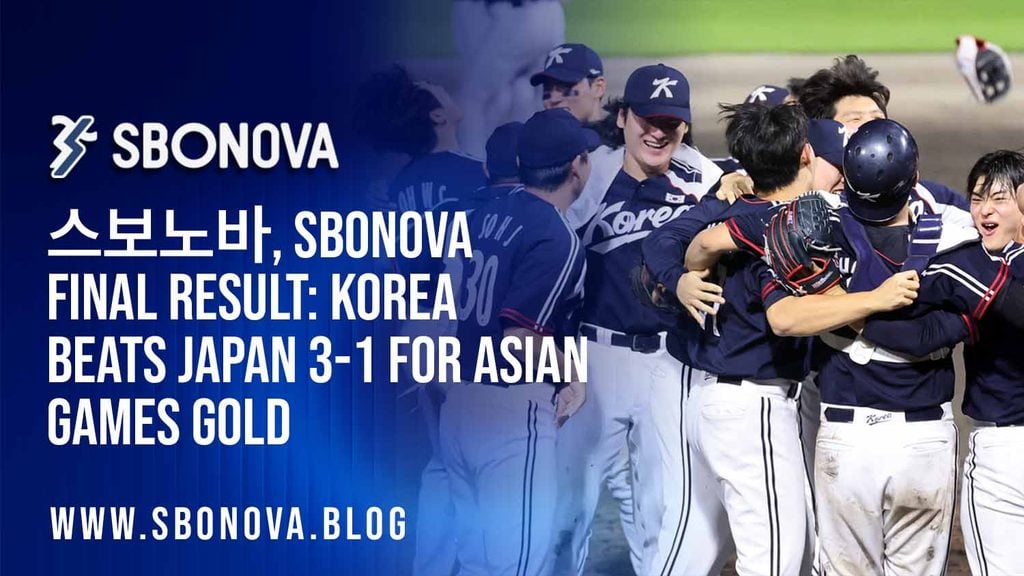
The gold-medal game was much tighter than the final score alone suggests. Korea took an early lead in the second inning when Yoon Dong-hee doubled and Moon Hyun-bin drove him home with a single, giving the defending champions a 1-0 advantage. Korea continued to put runners on base but repeatedly failed to turn those opportunities into additional runs. Yonhap News
That allowed Japan to remain within one swing of tying the game. The hosts eventually broke through in the bottom of the seventh, when Yuki Sato delivered a game-tying RBI single against starter Gwak Been.
Korea responded immediately. In the top of the eighth, Kim Ji-chan began the decisive sequence with a double. After the inning developed into another scoring opportunity, Kim Do-yeong’s infield single brought home the go-ahead run, and Moon Bo-gyeong followed with a single up the middle to make it 3-1. Yonhap News
The key final details were:
- Final score: South Korea 3-1 Japan
- Date: September 27, 2026
- Venue: Toyohashi Municipal Baseball Stadium, Japan
- Winning margin: Two runs
- Decisive inning: Top of the eighth
- Go-ahead hitter: Kim Do-yeong
- Insurance RBI: Moon Bo-gyeong
- Starting pitcher: Gwak Been
For readers following Korean international baseball throughout the tournament, see [Internal Link: SBONOVA Asian Games 2026 Coverage].
스보노바, SBONOVA Final Highlights: The Eighth Inning Changes Everything

The eighth inning was the most important offensive sequence of Korea’s championship game.
After Japan tied the score at 1-1 in the seventh, Korea could easily have allowed momentum to shift toward the home team. Instead, the lineup answered in its next opportunity.
Kim Ji-chan opened the inning with a double, creating immediate pressure. A sacrifice bunt and walk eventually put runners at the corners before Kim Do-yeong hit a hard ground ball toward third base. The play became an infield single and brought home Korea’s second run. Moon Bo-gyeong then added another RBI single to center, extending the advantage to 3-1. Yonhap News
The sequence was especially significant because Korea had struggled to convert earlier chances. The team put multiple runners on base several times, including loading the bases in the seventh, without adding to its early 1-0 lead.
Rather than relying on a home run, Korea won through a combination of extra-base hitting, situational baseball, baserunner advancement and consecutive productive at-bats.
For baseball followers analyzing close international games, that distinction matters. A team can create pressure without producing immediate runs, and the value of those opportunities often depends on whether the middle of the lineup can deliver when the score is tied late.
스보노바, SBONOVA Pitching Analysis: Gwak Been Controls the Final

Korea’s offense supplied the winning runs, but Gwak Been was the foundation of the victory.
The right-hander worked 6⅓ innings, allowing only one run on four hits while recording nine strikeouts. He held Japan hitless through the first four innings and escaped trouble after surrendering a leadoff double in the fifth. Yonhap News
His tournament contribution went beyond the final. In Korea’s opening 5-0 victory against Chinese Taipei, Gwak threw six scoreless innings and struck out 10. Across those two major starts, he gave Korea high-level pitching against two of its strongest opponents. Yonhap News
Japan finally reached him in the seventh inning of the final with three singles, including Sato’s tying hit. Jo Byeong-hyeon entered after the equalizer and struck out the next two batters, preventing Japan from taking the lead.
Park Yeong-hyun handled the late innings. He survived additional traffic on the bases and eventually recorded the final outs that confirmed Korea’s gold medal. Yonhap News
The pitching pattern showed why bullpen transitions are so important in tournament baseball. A strong starter can control most of the contest, but one difficult inning may force the manager to rely on high-leverage relievers with almost no margin for error.
SBONOVA KBO Baseball Guide 2026 can provide additional context on Korean pitchers and domestic baseball analysis.
스보노바, SBONOVA Tournament Results: Korea’s Road to the 2026 Gold Medal
Korea’s path to gold was not a perfect unbeaten run.
The team dominated Group B, opening with a 5-0 victory against Chinese Taipei before beating Hong Kong 13-0 and Thailand 18-1. Those three wins gave Korea a 3-0 group-stage record and a place in the Super Round. Official tournament results confirm Korea finished first in Group B. Japan Baseball
The tournament then became considerably more difficult.
Group Stage Results
- Korea 5-0 Chinese Taipei
- Korea 13-0 Hong Kong
- Korea 18-1 Thailand
Korea scored 36 runs across those three games while allowing only one.
Super Round Results
The first major setback came against Japan on September 25. Korea was shut out 5-0, managing only four hits against Japanese starter Shin Higuchi. Yonhap News
That loss made the following game against China crucial. Korea recovered with a 9-2 victory, overcoming an early deficit to reach the gold-medal game. Starter Choi Min-seok provided seven innings of one-run pitching while Korea’s lineup produced enough offense to set up a rematch against Japan. Yonhap News
Gold-Medal Game
Korea 3-1 Japan
The difference between the 5-0 Super Round defeat and the 3-1 championship victory is one of the most interesting parts of Korea’s tournament. The team did not need to dominate every opponent. It needed to adjust after its loss and execute better when the medal was on the line.
스보노바 신규 가입 100% 첫 입금 보너스
글로벌 메이저 플랫폼에서 제공하는 특별한 혜택을 놓치지 마세요.
- ✓ 글로벌 최고 수준의 스포츠 배당률
- ✓ 해외 정식 라이선스 기반의 안전성
- ✓ 신속하고 투명한 입출금 시스템
18세 이상만 이용 가능 · 책임감 있는 게임
The final standings placed Korea first, Japan second, Chinese Taipei third and China fourth. Japan Baseball
스보노바, SBONOVA Key Players Behind Korea’s Baseball Gold Medal
Several players influenced Korea’s championship run, but the final placed particular attention on three areas: starting pitching, late-inning hitting and relief pitching.
Gwak Been delivered the biggest pitching performance. His 6⅓ innings kept Korea ahead or level for almost the entire championship game.
Kim Do-yeong produced the defining offensive moment. Although he did not have a dominant tournament statistically, he delivered the go-ahead infield hit with the gold-medal game tied in the eighth. He finished the six-game tournament 6-for-24, making the timing of his decisive hit more significant than his overall batting average. Yonhap News
Moon Bo-gyeong followed immediately with an RBI single that gave Korea valuable breathing room.
Moon Hyun-bin also deserves attention. Entering the final after going 2-for-17 earlier in the tournament, he drove in Korea’s first run with a second-inning single. Yonhap News
In the bullpen, Jo Byeong-hyeon was asked to enter at the most dangerous point of the seventh inning. His two strikeouts stopped Japan from building on its tying rally, while Park Yeong-hyun completed the late-inning work.
These contributions show why tournament performance should not be judged only by overall averages. Individual at-bats, matchup situations and high-leverage pitching appearances can have much greater impact than raw totals.
스보노바, SBONOVA Explains Why Korea’s Fifth Straight Gold Matters
The result extended one of Korea’s strongest runs in Asian Games baseball.
South Korea has now won five consecutive Asian Games baseball gold medals, continuing a championship streak that began at Guangzhou 2010 and continued through Incheon 2014, Jakarta-Palembang 2018, Hangzhou 2022 and Aichi-Nagoya 2026. The Korea Herald
The 2026 title was different from a straightforward dominant tournament because Korea had already lost convincingly to Japan before the final.
A 5-0 defeat exposed offensive problems during the Super Round. Two days later, Korea faced essentially the same challenge with a gold medal at stake and found a different result.
That makes the championship useful for evaluating tournament baseball beyond win-loss records. Short international competitions reward teams that recover quickly, manage pitching carefully and adapt to opponents they may face more than once.
스보노바, SBONOVA Baseball Analysis: What the Final Tells Us
Three elements stand out when reviewing Korea’s 2026 Asian Games final.
First, starting pitching protected the team during its offensive struggles. Korea left opportunities unfinished for much of the game, yet Gwak’s performance prevented those missed chances from becoming decisive.
Second, the lineup responded immediately after Japan tied the score. That eighth-inning response changed the pressure of the game and forced Japan to chase two runs rather than protect a tie.
Third, Korea’s bullpen handled high-leverage situations effectively. Jo entered when Japan had just tied the game, while Park faced late baserunners with the championship still within Japan’s reach.
For readers evaluating future Korean baseball games, these are useful areas to follow alongside basic final scores:
- Starting-pitcher workload and strikeout ability
- Production with runners in scoring position
- Bullpen usage in the seventh inning or later
- Performance after falling behind or surrendering a lead
- Results in repeat matchups against the same opponent
- Defensive execution and baserunning under pressure
A deeper domestic perspective can be added through SBONOVA Baseball Betting Guide 2026.
스보노바, SBONOVA FAQ About Korea’s 2026 Asian Games Baseball Gold
Who won the 2026 Asian Games baseball gold medal?
South Korea won the men’s baseball gold medal by defeating Japan 3-1 in the final on September 27, 2026, at Toyohashi Municipal Baseball Stadium. Yonhap News
How many consecutive Asian Games baseball gold medals has Korea won?
The 2026 victory gave South Korea its fifth consecutive Asian Games baseball gold medal, continuing a title streak dating back to the 2010 Guangzhou Games. The Korea Herald
Who scored the winning run against Japan?
Kim Do-yeong produced the go-ahead RBI with an eighth-inning infield single. Moon Bo-gyeong followed with another RBI single, extending Korea’s lead to 3-1.
How did Gwak Been perform in the final?
Gwak pitched 6⅓ innings, allowing one run on four hits while striking out nine. He kept Japan hitless through the first four innings and left after Japan tied the game in the seventh. Yonhap News
Did Korea lose any game during the 2026 Asian Games?
Yes. Japan defeated Korea 5-0 in the Super Round on September 25. Korea then beat China 9-2 before defeating Japan 3-1 in the gold-medal rematch. Japan Baseball
What were Korea’s 2026 Asian Games baseball results?
Korea defeated Chinese Taipei 5-0, Hong Kong 13-0 and Thailand 18-1 in Group B. It lost 5-0 to Japan, defeated China 9-2 in the Super Round and then beat Japan 3-1 in the final. Japan Baseball
👇 글로벌 프리미엄 메이저 플랫폼 스보노바 공식가입 👇

실시간 라이브 카지노의 압도적인 몰입감
공식 라이선스 업체에서 제공하는 100% 투명하고 안전한 게임 경험.
- ✓ 글로벌 최고 수준의 스포츠 배당률
- ✓ 해외 정식 라이선스 기반의 안전성
- ✓ 신속하고 투명한 입출금 시스템
18세 이상만 이용 가능 · 책임감 있는 게임